
Introduction
Back pain is one of the most common complaints in homes and offices across India. Whether you are working from home, sitting at an office desk, or relaxing at home, the wrong chair can create serious problems for your spine and overall health.
The good news? Choosing the right furniture can reduce back pain significantly.
Ergonomic chairs and recliners are designed specifically to support your lower back, align your spine properly, and reduce the strain that causes pain.
In this guide, Palazzo Furnitures will walk you through everything you need to know about ergonomics and recliner chairs, how they work, which type suits you best, and how to find the perfect one for your home interiors.
By the end, you will have a clear plan for choosing furniture that keeps your back healthy and comfortable.
Key Takeaways
- Poor Seating Causes Chronic Back Pain: Lower back carries 50% of body weight. Without proper support, pain develops in 30-60 minutes.
- Ergonomic Chairs Reduce Back Strain by 30%: Proper lumbar support maintains spine’s natural curve, reducing spinal pressure compared to regular chairs.
- Reclined: at 110-130 degrees reduces spinal disc pressure by 40%, ideal for pain relief.
- Relief Takes 2-3 Weeks: Initial relief within 3-7 days. Significant pain reduction takes 2-3 weeks as body adjusts.
- Different Rooms Need Different Furniture: Invest in ergonomic office chairs (work), recliners (relaxation), dining chairs (meals), and quality beds (sleep).
- Quality Chairs Save Money Long-Term: Quality chairs last 5-7 years and prevent expensive medical treatment. Budget chairs increase pain.
What Is an Ergonomic & Recliner Chair?
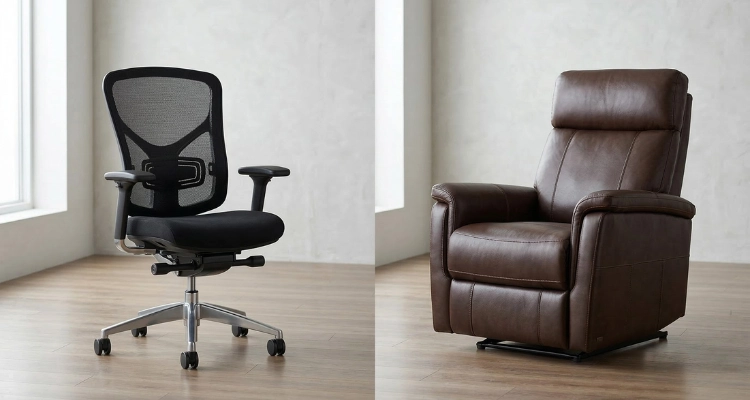
An ergonomic chair is designed with your body in mind. It has features that support your spine’s natural shape, adjust to fit your body size, and keep you comfortable during long hours of sitting. Think of it as furniture that works with your body, not against it.
Key parts of an ergonomic chair include lumbar support (a curved area that supports your lower back), adjustable seat height, proper armrests, and a seat depth that allows your feet to rest flat on the ground.
A recliner chair is built for comfort and relaxation. It reclines backward and often has a footrest that lifts as you lean back. Recliners distribute your body weight across a larger surface area, reducing stress on your spine. They are perfect for home interiors where you want to relax, recover, or watch television.
The main difference? Ergonomic chairs keep you alert and upright for work, while recliners prioritize comfort and recovery.
Why Does Back Pain Develop from Poor Seating?
Most back pain starts with how you sit. When you use a chair without proper support, your spine doesn’t maintain its natural curve. Your lower back muscles must work extra hard to hold you upright, causing fatigue and pain within 30-60 minutes.
Common seating mistakes include chairs that are too soft, seats that are too high or too low, and backrests that don’t match your spine’s curve. These small problems add up over weeks and months, turning temporary discomfort into chronic pain.
Your lower back carries 50% of your body weight when sitting. Without proper support, this weight concentrates on your discs and ligaments, damaging them over time. This is why furniture for your home interiors and office matters so much; it affects your health every single day.
People who sit 6-8 hours daily in poor chairs often experience long-term spine issues. Children and elderly family members are even more vulnerable, making the right chairs essential for any home.
How Ergonomic & Recliners Help Relieve Back Pain?
Ergonomic chairs reduce spinal pressure by maintaining proper alignment. When you sit correctly, your spine stays in its natural S-curve. This distributes your weight evenly instead of concentrating it in one spot. Studies show this reduces back strain by up to 30%.
The lumbar support in ergonomic chairs is the most important feature. It fills the gap between your lower back and the seat, preventing your spine from slumping forward. Adjustable lumbar support lets you customize this support to match your body perfectly.
Recliners provide different relief. When you recline at the right angle (about 110-130 degrees), your spinal discs experience 40% less pressure than when sitting upright. Full-body support means your neck, shoulders, and lower back all get relief at the same time.
Both chair types work best when combined with proper posture habits. The right chair can reduce pain in days, but complete relief often takes 2-3 weeks as your body adjusts to proper alignment.
What Are the Types of Chairs for Back Pain Relief?
- Ergonomic office chairs are built for work. They have adjustable lumbar support, seat height controls, tilt mechanisms, and armrests. They keep you alert while protecting your spine during 6–8 hours of workdays.
- Recliners come in manual (you push a lever) and power (motorized) versions. They’re perfect for living rooms and bedrooms, offering therapeutic support for relaxation and recovery.
- Rocking chairs use gentle motion to engage your core muscles and improve circulation. They are ideal for elderly family members or anyone who wants light, therapeutic movement.
- Dining chairs with back support are often overlooked but important. Poor dining chair design forces awkward posture during meals, contributing to cumulative back pain.
- Executive chairs combine professional style with ergonomic support. They are suited for home offices and formal spaces.
Comparison: Ergonomic vs. Recliner vs. Rocking Chairs
Feature | Ergonomic Office Chair | Recliner | Rocking Chair |
Best For | Work, focused tasks (6-8 hours) | Relaxation, recovery, leisure | Gentle movement, circulation |
Back Support | Adjustable lumbar + firm | Full-body support | Traditional lumbar curve |
Spinal Load | Low (when adjusted) | Very low (when reclined) | Low (movement reduces stiffness) |
Best for Elderly | Good | Excellent | Good |
Best for Office | Excellent | Poor | Not suitable |
Adjustability | High | Medium | Low |
Space Needed | Compact | Medium-Large | Medium |
Features to Look for in an Ergonomic & Recliner Chair
1. Lumbar support is the single most important feature. It should be adjustable both up-down and in-out so you can position it exactly where your lower back curves.
2. Seat height should allow your feet to rest flat on the ground with knees at 90 degrees. Most quality chairs offer 17–21-inch heights. Too high or too low creates posture problems.
3. Seat depth matters more than people think. It should be 16-18 inches so that when you sit with your back against the seat, you have 2-3 inches of space behind your knees. This prevents circulation problems.
4. Armrests should be at elbow height when you are sitting with your shoulders relaxed. Proper armrests reduce strain on your neck and shoulders.
5. Tilt mechanism lets you recline slightly during the day, reducing spinal load. A good tilt lock holds your preferred position without drifting.
6. Material quality matters for long-term comfort. Breathable fabrics prevent heat buildup during extended sitting. Leather is durable but can feel hot in Indian summers.
7. Warranty shows the manufacturer’s confidence. Quality chairs usually come with 2–3 years warranties.
Who Should Consider Buying an Ergonomic & Recliner?
- Office workers sitting 6-8 hours daily absolutely need ergonomic support. The investment prevents decades of back problems.
- Remote workers should treat their home office seriously. Home furniture is just as important as office furniture.
- Elderly family members benefit from both ergonomic support and reclining features. Higher seat heights make standing easier, and full-body support reduces pain.
- Students studying for long hours need proper back support to prevent posture problems early.
- People with existing back pain often find symptom relief within days of switching to proper chairs.
- Athletes and active people need firm support without excessive padding.
- Anyone spending 4+ hours daily sitting should consider investing in quality furniture for their home interiors.
Step-by-Step Checklist for Selecting a Right Chair
Step 1: Assess Your Sitting Duration
- Less than 4 hours/day → Standard comfortable chair
- 4-8 hours/day → Ergonomic office chair
- 8+ hours/day → Premium ergonomic chair
Step 2: Measure Your Body
- Sit with back against wall, feet flat
- Measure from seat to where your lower back curves
- Note your elbow height (for armrests)
Step 3: Test Adjustability
- Sit in the chair for 5-10 minutes
- Adjust lumbar support until it fits perfectly
- Change seat height and armrest positions
- Adjust move smoothly
Step 4: Check Firmness
- Sit for 20 minutes (not just 2-3 minutes)
- Your lower back should maintain its curve
- You shouldn’t sink deeply into the cushion
Step 5: Evaluate Long-Term Comfort
- Can you adjust it for different tasks?
- Does it support your arms properly?
- Will you stay comfortable for 8 hours?
Step 6: Verify Warranty
- Check return policy (usually 15-30 days)
- Confirm warranty period (minimum 2 years)
- Understand what’s covered
Top Picks: Best Ergonomic & Recliner Chairs in India (2026)
1. Budget Range: Basic ergonomic chairs with fixed lumbar support. Good for occasional use, not suitable for 8-hour daily sitting.
2. Mid-Range: Adjustable lumbar support, seat height controls, and breathable fabric. Ideal for most remote workers and office professionals.
3. Premium: Multiple adjustment options, high-quality materials, and strong warranties. Best for people sitting 8+ hours daily.
4. Luxury Recliners: Power-operated recliners with memory foam, heat therapy, and massage features. Perfect for therapeutic use in home interiors.
How Do Specific Palazzo Furniture Products Address Back Pain?
1. Designer Sofa Sets combine style with ergonomic support. They are perfect for living rooms where you spend 2-4 hours daily, offering proper lumbar curves and adjustable cushions.
2. Relaxing Chairs & Recliners are specifically built for spinal relief. Smooth reclining mechanisms, footrests, and headrests provide complete body support for recovery and leisure.
3. Ergonomic Dining Chairs support your back during meals. Many people ignore dining chairs, but poor seating during 30-minute meals contributes to cumulative pain.
4. Complementary Furniture matters too. Proper bedside tables at the right height reduce awkward reaching movements that strain your back. Quality exquisite luxury beds paired with appropriate support furniture create healthy sleep environments.
5. Outdoor Furniture with back support, extend healthy seating habits to your balcony and garden areas.
6. Highchair-Bar Stools with footrests ensure proper posture at kitchen counters and dining bars.
Why Choose Palazzo Furnitures for Ergonomic & Recliner Chairs?
- Expertise Home Interiors. Palazzo Furnitures understands Ahmedabad homes and how furniture fits into complete interior designs, not just isolated pieces.
- Quality Standards. All furniture meets ISI certification and international safety standards. Each piece is tested for durability, stability, and material safety.
- Customization Available. Need specific colors, sizes, or features? Palazzo offers customization options to match your space and requirements perfectly.
- Expert Consultation. Their furniture specialists help you choose exactly what your body and space need—not what’s cheapest or most popular.
- Warranty & Support. 2-year warranties, free delivery in Ahmedabad, and professional installation ensure your investment is protected.
- Showroom Experience. Visit the Ahmedabad showroom to test chairs before buying. Feel the lumbar support, test the adjustments, and experience comfort firsthand.
How to Maintain Your Ergonomic Recliner Chair?
1. Daily Care Dust your chair regularly and wipe it with a damp cloth. Don’t let spills sit—clean immediately to prevent staining.
2. Mechanism Maintenance Check that all moving parts (height adjusters, tilt locks, recline mechanisms) move smoothly. Oil squeaky hinges with silicone spray (not oil).
3. Fabric Cleaning Use a fabric brush for upholstered chairs. For leather, use leather-specific cleaners monthly. Vacuum weekly to remove dust.
4. Adjustment Checks Every 3-6 months, verify that lumbar support and other adjustments still work properly. Tighten loose bolts using the provided tools.
5. Lifespan Extension A well-maintained chair lasts 5-10 years. Avoid jumping on chairs, don’t exceed weight limits, and follow the manufacturer’s care instructions.
Why Ergonomic & Recliner Chairs Are So Popular in 2026
- Health consciousness is rising. Indians are increasingly aware that poor posture causes long-term health problems.
- Remote work boom. Post-pandemic, millions work from home and invest in proper home office furniture.
- Wellness becomes a priority. People spend ₹ thousand on gym memberships but neglect the furniture they sit in for 8 hours daily. This mindset is changing.
- Insurance recognition. Some health insurance plans now cover ergonomic furniture as preventive health equipment.
- An aging population. With more elderly people living independently, demand for furniture supporting mobility and comfort increases.
Conclusion
Back pain doesn’t have to control your life. The right chair, whether an ergonomic office chair, relaxing recliner, or designer sofa set—supports your spine and keeps you comfortable throughout your entire day.
Investing quality furniture for your home interiors is investing in your health. Ergonomic chairs beat years of pain management, physiotherapy, and lost productivity.
Ready to transform your seating? Here’s what to do next:
Request a Custom Quote. Get pricing on specific furniture for your home or office from Palazzo Furnitures.
Frequently Asked Questions (FAQs)
1. How long before an ergonomic chair helps back pain?
Most people feel relief within 3-7 days as muscles adjust to proper posture. Significant pain reduction takes 2-3 weeks, but if there’s no improvement after 3 weeks, check if your chair is properly adjusted.
2. Can an expensive chair cure existing back pain?
No, a chair cannot cure existing pain because the problem often comes from previous injuries or muscle damage. A good chair prevents pain from getting worse and reduces strain, but you need physiotherapy and medical evaluation to cure the pain.
3. Should I recline my office chair while working?
Yes, recline occasionally every 45 minutes to reduce spinal load and prevent muscle fatigue. However, return to an upright position for focused work because reclining reduces the alertness needed for concentration.
4. How often should I adjust to lumbar support?
Adjust lumbar support when you first use the chair to match your back’s natural curve. Then check every 3-6 months because cushions settle and compress with regular use.
5. Are budget chairs suitable for back pain?
Budget chairs lack adjustability and proper lumbar support features. If you sit 4+ hours daily, invest in quality chairs that provide proper customization for pain relief.
6. Can a recliner replace an office chair?
No, because recliners provide comfort but reduce the alertness and upright posture needed for focused work. Use both in different spaces—ergonomic chairs for work and recliners for relaxation and recovery.
7. What’s the ideal reclining angle?
The ideal reclining angle is 110-130 degrees because your spine experiences 40% less pressure at this angle. Avoid fully flat (180 degrees) for extended periods as it can strain your neck.
8. How do I know if my chair needs lumbar support?
If you feel back fatigue within 30 minutes of sitting or notice yourself slouching forward, your chair lacks adequate support. Add a lumbar pillow or upgrade to a chair with adjustable lumbar support.